


In the Makerspace classes at Woodbridge High, students trade desks and worksheets for 3D printers and robotic arms that go far beyond traditional Science Technology Engineering and Math (STEM) classes.
Makerspace as a program has come a long way from its roots as a Woodbridge High club in 2019.
“Everyone was coming back from COVID and we needed to get some good hands-on stuff classes,” Makerspace teacher Daniel Pilchman said. “The principal asked me to create something new that was sort of science-y and stand-in [and] hands-on.”
It began with a few classes in the science building, and it continued to grow as students gained more interest in hands-on learning and technical jobs. Now the Makerspace program has four class levels beginning with Design Lab as the first level, followed by animatronics and design, the third level being model and prototyping (DMP) which is also a dual enrollment class and finally electrical technology, another dual enrollment class with Irvine Valley College (IVC).
These classes differ a lot from the typical STEM class, featuring the freedom for students to create what they choose.
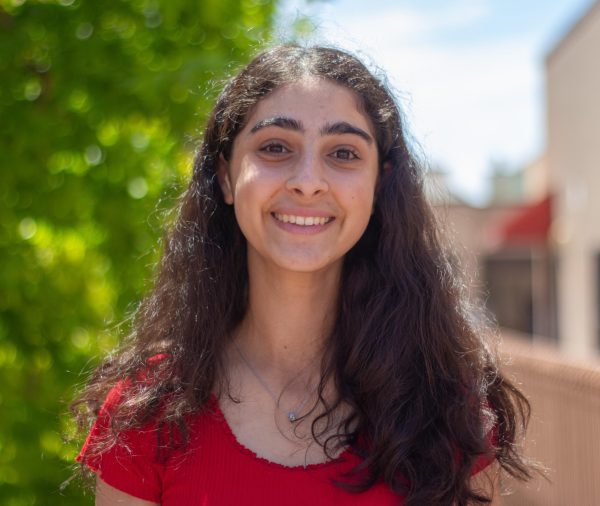
“My favorite thing is how much freedom we have,” animatronics student Taha Baghalianzadeh said. “We can pretty much design and build whatever we want, and there’s a ton of materials and tools to help us do it.”
This freedom comes from all of Pilchman’s support and a vast variety of materials, which makes this a STEM class a place where creativity can flow and math and science connect to music and design. Pilchman’s support can take students through most of the journey, but it’s their creativity and willingness to explore that leads to the final result.
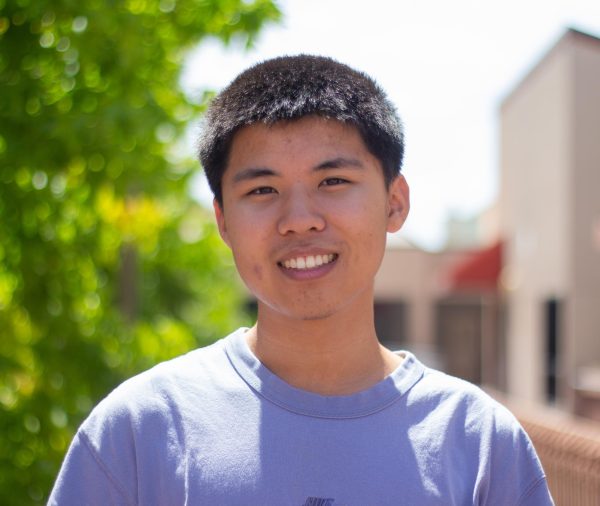
“Two years ago I made an animatronic bird and then I got to go to Physics Day with it and we won, so that was pretty cool,” electrical technology student Sonia Sotnikova said.
Sotnikova’s creativity allowed her to make the project, but her determination to make something unique, is what got her first prize at Physics Day, the Knot’s Berry Farms field trip in spring semester In addition to her animatronic bird project, in the Design Lab class, students get to learn about electricity and sound by building a fully functional electrical guitar and eventually are allowed to take it home once it is finished.
“Makerspace is different because it’s all hands-on. Instead of just doing worksheets or equations, you actually get to build things and learn by doing,” Baghalianzadeh said.
In addition to this program being a mix of fun and hands-on learning, it also provides students with a unique opportunity for career exploration.
“The whole point of the class and of my pathway is that I’m trying to help students find jobs,” Pilchman said.
He achieved this goal with Sotnikova, helping her further her interest in electrical engineering.
“I feel like I’m getting almost a taste of [how] college will be,” Sotnikova said. “I want to go into electrical engineering and so being able to do these labs and working with these arduino and stuff like that I feel like ‘oh like I’m getting experience and I’m gonna feel more prepared!”
With every project there comes the need for materials, and instead of Pilchman doing the ordering and coordinating to get the materials himself, he passes on this task to his students. If students needed silicone for a project, Pilchman has two companies he can connect them to. If the student getting the materials wants to go into special effects or props for television, he would put them in contact with Reynolds Advanced Materials in Burbank to get the silicone, and if they are more interested in aerospace, he would connect them with the same company, but the Pomona store which supplies materials for the Jet Propulsion Lab.
“That’s what we do is we build partnerships with local businesses and then I want to introduce my students to them because maybe that’s where they’re going to go work,” Pilchman said.
Students not only gain access to cool and new materials, but they also get exposed to new technologies.
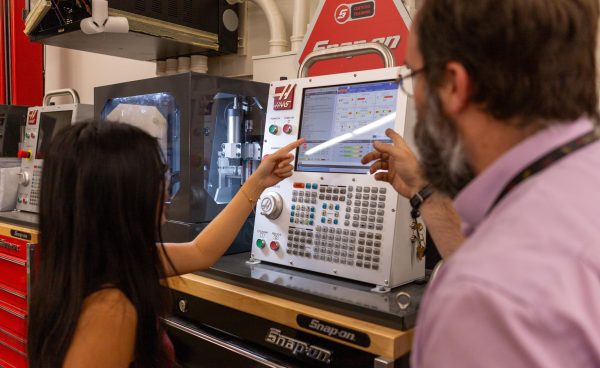
Pilchman is most excited about their new Computer Numerical Control (CNC) mill which has opened many possibilities for new projects for the students.
“I can put in a block of any material and create a computer program to have it carve that material,” Pilchman said. “So I can have it cut wood, ceramic, I can have it cut steel, I can have it cut aluminum, bones, really anything that I want we can pop in there.”
These new technologies allow students to explore the world of Artificial Intelligence (AI) through a robotic arm.
Baghalianzadeh explained that he has used an iPad to program the arm and to make it do different tasks.
“We are teaching it how to write, right now, but…we can use AI with it. It has a robot vision sensor so we can see what it’s doing and process that using AI,” Pilchman said.
In December, Pilchman and his students in Makerspace used the robotic arm as a live AI artist for Woodbridge High’s Glow in the Park event. They programmed the arm to use a Sharpie and draw festive designs for the event.
Each project the students work on is a long journey spanning across eight weeks.
“We go all the way from coming up with our concepts through full fabrication and then distribution to whoever it is that’s going to be our end user,” Pilchman said.
After learning the concepts and completing each project, every student has a different takeaway from their class.
Baghalianzadeh’s project of a severed hand candle stand for Halloween was his favorite and most memorable project.
Sotnikova also reflected on her past projects, and mentioned that she felt especially meaningful when she saw them used outside the classroom, for example, the prosthetics she made for the Cowardly Lion and the Wicked Witch of the West in ‘The Wizard of Oz’ musical.
“I went to go watch the musical and I’m like ‘dang like I lowkey made that!’” Sotnikova said.
Ultimately, the biggest lesson a student can walk away with is discovering what they’re interested in and creating things they never thought they could make before.
As for many students, that discovery starts with simply being willing to explore and try something new, a mindset that Sotnikova says defines the class.
“You never know what you’ll actually end up liking,” Sotnikova said. “It’s always gonna be fun at the end anyway.”