


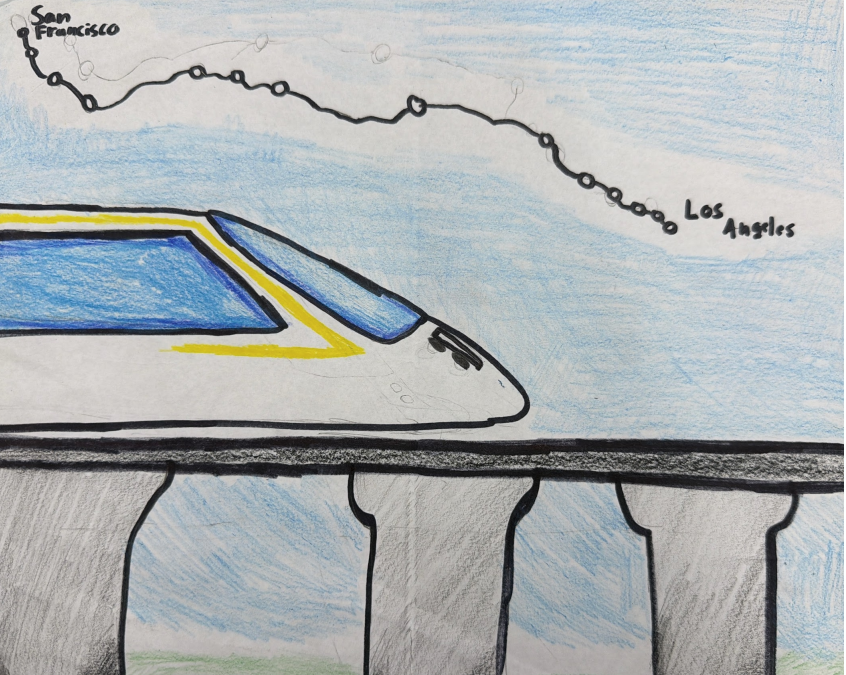
In 2008, Californian voters approved the California high-speed rail project, an ambitious plan to connect San Francisco and Los Angeles. Nearly two decades later, the project remains unfinished as costs have risen from an estimated $33 billion to well over $100 billion, while the larger transportation system has been reduced largely to the Central Valley.
As construction delays and funding concerns continue, Californians have begun to wonder whether this high-speed rail should remain a state priority over other public needs and services. Some taxpayers and opponents of the project argue that redirecting a portion of the railway’s $100 billion toward schools and welfare programs could better support struggling Californians by improving educational resources and public services across the state.
Since its inception, the California high-speed rail project has more than tripled in cost from $33 billion to over $100 billion, according to Politico. Although the High Speed Rail Authority intended to rely on federal, state and private funding in equal measure, changes in presidential administrations have complicated matters. According to Grist, federal funding was first granted by the Obama administration after the Great Recession.
In 2025, the Federal Railroad Administration withdrew significant federal grants from the project under the Trump administration. The lack of federal support has placed a greater financial burden on California taxpayers. California has provided 75 percent of the funding for the project so far, increasing the responsibility put on taxpayers, according to Grist.
In addition to issues regarding funding, the project’s transparency has also been brought into question. According to CalMatters, Assembly Bill 1608 was proposed to keep certain investigative records about the project from public disclosure. Such developments could make it more difficult for the public to monitor progress, which has already been met with significant delays. Questions surrounding the project’s planning process have also contributed to public concern, as Woodbridge High School social studies and AP United States Government teacher Christopher LePage explains.
“When it was proposed to the people in 2008, Proposition 1A, the people were not aware that the land had not even been allocated yet for the train or the high-speed rail,” LePage said.
The project’s rising costs, delays and lack of transparency have caused many Californians to question whether continued investment in the railway remains worthwhile.
Despite the setbacks, there are still many proponents of the California High Speed Rail project. The California High Speed Rail Authority argues the project will bring greater economic growth in the future. The project has created thousands of construction jobs in the Central Valley, and the rail has the potential to boost local economies in the region. As a state largely dependent on cars and highways, California could benefit from expanded public transportation options, as Woodbridge High School Junior Hana Ali shares.
“Public transport across the United States in general is very poor… in California, an expansion of it can really help improve the livability of our state,” said Ali.
According to the High Speed Rail Alliance, expanded public transportation could also reduce California’s environmental impact and improve economic development. However, critics argue that
these benefits are outweighed by the project’s growing cost, and continued delays raise doubts about whether these goals will be implemented.
Instead of devoting excess money to the high-speed rail project, detractors of the rail argue that some of the money being put into the high-speed rail project could be redirected toward other public needs, as Woodbridge High School Junior Summerlyn De Alba states.
“I feel like a lot of [money] would be better put into funding schools and into funding welfare agencies,” De Alba said.
According to the California Budget & Policy Center, the Republican H.R. 1 cut significant funds from health care and food assistance, causing millions of Californians to lose access to Medi-Cal coverage.
Other anti-poverty programs have also faced crippling financial reductions. According to the County Welfare Directors Association of California, the US Department of Health and Human Services froze funding for initiatives like the Child Care and Development Fund and the Social Services Block Grant.
Diverting some funding from the high-speed rail project to struggling public welfare programs could provide more immediate benefits for Californians. However, that doesn’t mean the project should be shut down entirely.
“The benefits of having an easily accessible mode of transportation for those who cannot afford transportation, such as students, elderly people, recent graduates… really overrides the possible
detriments of having months of construction,” Ali said.
Increased and more consistent federal funding would also alleviate the burden set on taxpayers. “What the state should do is appeal for more federal funding than just state funding” LePage said.
With more money from the federal government, vital municipal services like fire prevention and water- based services could be better supported. The problem at hand isn’t just the high-speed rail project, but overall mismanagement of funds. With better planning and budgeting, funds could be distributed in a way that accurately reflects the needs of Californians across the board.
“Ensuring that we have proper funds and a balanced budget to continue a project like this while also ensuring we have welfare… [is] top priority,” Ali said.
If a portion of the money spent on the railway were redirected toward areas of greater need, it could help millions of Californians. Increased funding for schools could improve education by providing students with meals, better equipment, and learning opportunities. Students could also stay informed about current events and advocate for change by contacting and participating with legislators.